
9th October 2026 | By Admin
Picture two products on a chemist's counter. One is a regular tablet of Vitamin D3. The other is a small, glossy, liquid-filled softgel with the same vitamin dissolved in oil. Ask a doctor which one they would rather prescribe to a patient who struggles with absorption, and a good number will point at the softgel. That quiet preference is the reason soft gelatin capsules keep gaining shelf space in India, and the reason a soft gelatin capsule third party manufacturing company has become one of the most useful partners a pharma marketer can have.
But softgels are not like other dosage forms. You cannot make them by tweaking a tablet line, and you cannot set up a plant for them over a weekend. This article explains how softgels actually work, what to look for in a manufacturing partner, and how businesses are using them to build ranges in neuro care, women's health, nutrition, and more.
A soft gelatin capsule is a single, sealed, one-piece shell made mostly of gelatin, softened with a plasticizer such as glycerin or sorbitol, and filled with a liquid or semi-solid. Unlike a two-piece hard capsule, which is filled with powder and then closed, a softgel is formed and filled in the same moment on a rotary die machine. The shell closes around the fill, seals itself, and is later dried and polished.
That one difference changes everything about what the product can do. Oils, oil-based suspensions, and drugs that dissolve poorly in water can be delivered in a ready-to-absorb form. Low-dose actives get distributed evenly because they are dissolved or suspended before encapsulation, not blended as powder. And the sealed shell protects sensitive ingredients from air and light better than most open-structure forms.
Brand owners usually come to softgels for one of three reasons. The first is absorption: ingredients such as Vitamin D3, CoQ10, DHA, lycopene, and progesterone behave better when delivered in an oil-based fill. The second is patient acceptance: softgels are smooth, easy to swallow, and free of the chalky taste that some tablets carry. The third is differentiation. In a market crowded with look-alike tablets, a well-presented softgel stands out to both doctors and patients, and it often supports a stronger price position.
None of this matters, of course, if the product is inconsistent. A softgel that leaks, sticks together, or turns brittle in a humid warehouse can sink a brand quickly. That is why the manufacturer you choose matters more here than with almost any other format.
Softgel manufacturing needs a gelatin melting and mixing section, fill preparation vessels, an encapsulation machine with matched dies, tumble and tray drying rooms with tight humidity control, and a polishing and inspection stage. Add skilled operators, validation, and licensing, and you are looking at a heavy investment with a long runway.
For a PCD franchise owner or a distributor, that is rarely the best use of capital. Handing production to an established third party manufacturer lets you launch faster, keep your focus on doctors and distribution, and avoid carrying technical risk that you have no real reason to own.
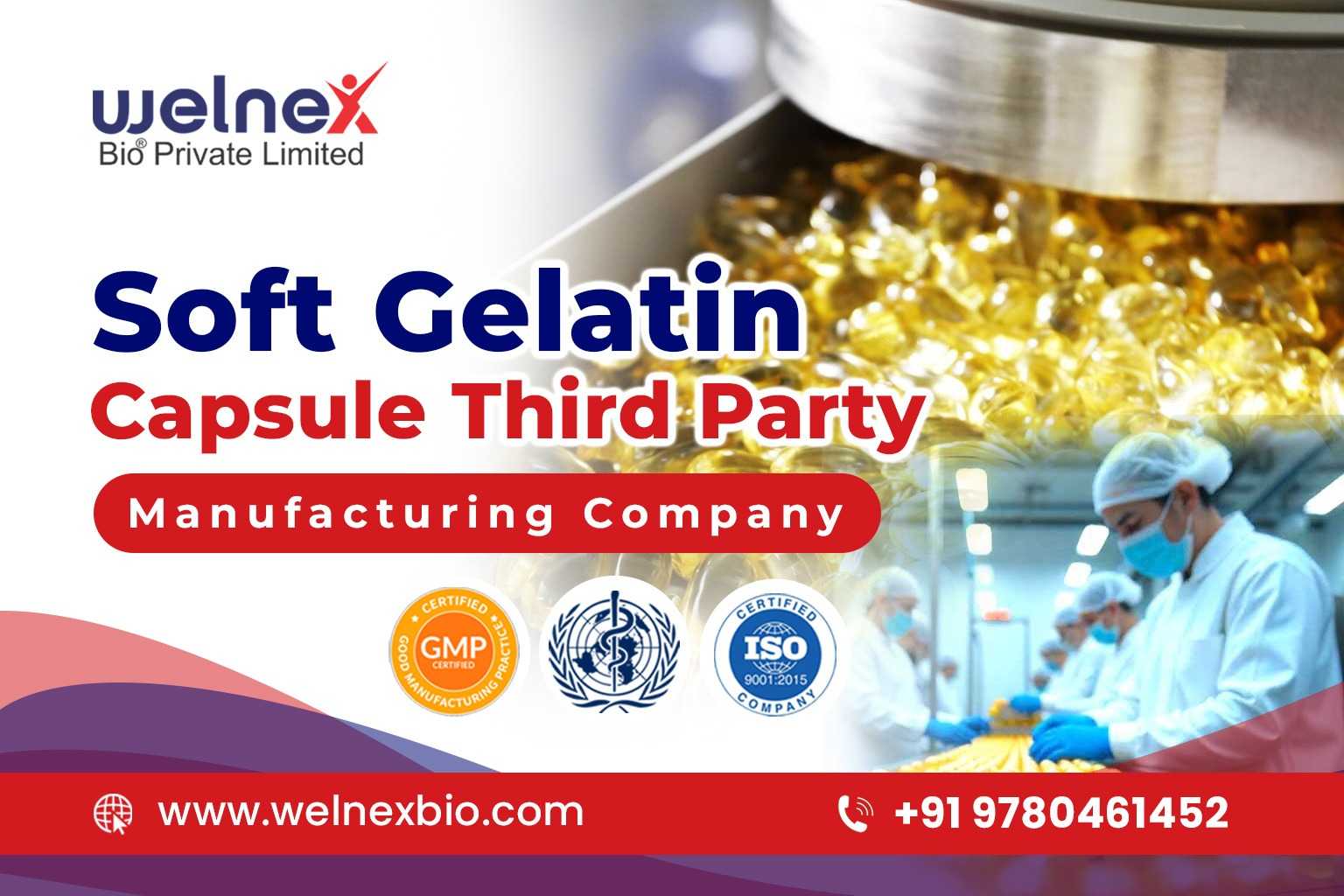
Welnex Bio Pvt. Ltd. has been manufacturing from Panchkula, Haryana since 2017, and its soft gelatin capsules catalogue is organised by therapy segment. Here is how the range breaks down.
Neuroprotective softgels. This is the largest segment, with close to twenty formulations. Most combine Methylcobalamin with Alpha Lipoic Acid, Folic Acid, Benfotiamine, Inositol, and Chromium, and some pair Methylcobalamin with Pregabalin for nerve pain support. Others combine Tocotrienols with Vitamin D3 and L-Methylfolate. If you are building a neuro division, this one range can fill a full product list on its own.
Infertility and women's health softgels. The infertility/gynaecology segment includes CoQ10 with Lycopene, L-Arginine, Zinc, and Selenium combinations, Evening Primrose Oil in different strengths, DHA-based formulations, and Progesterone softgels in multiple strengths. These products are a natural fit for gynaecologists and fertility clinics.
Hematinics. Iron-based softgels such as Ferrous Ascorbate with Folic Acid and Zinc, and Ferrous Bis-glycinate multi-nutrient blends, serve the anaemia and antenatal market. The hematinics category is steady and prescription driven.
Multivitamin and nutrition softgels. The multivitamin range includes Cholecalciferol 60000 IU, Vitamin E in different strengths, Vitamin C with Vitamin E, and antioxidant and probiotic combinations. Many brands use this segment to enter the wellness market without heavy clinical selling.
Anti-inflammatory and cold range. Dexibuprofen with Paracetamol, and several cough and cold combinations such as Dextromethorphan with Bromhexine and Guaiphenesin, are available in softgel form for faster, smoother relief.
Respiratory support. An anti-asthmatic softgel combining Camphor, Menthol, Eucalyptol Oil, Terpineol, and Chlorothymol rounds out the catalogue.
One manufacturer covering all of these segments means you can plan a multi-division brand without stitching together suppliers who each follow different quality habits.
Experienced buyers learn to look for specific warning signs. Knowing them helps you judge any soft gelatin capsule third party manufacturing company before you place an order.
Leakage is the first. It usually points to a poor seal or an incompatible fill. Stickiness and clumping, often after dispatch, point to weak drying control. Brittle or overly soft shells hint at imbalance between gelatin and plasticizer, or at poor storage. Discolouration, cloudiness in the fill, and weight variation between capsules are further red flags.
Ask any prospective partner how they test for these problems. A serious manufacturer will talk about shell integrity checks, fill weight verification, disintegration testing, and stability studies without hesitation. Vague answers are your cue to keep looking.
Rather than relying on a generic checklist, go in with questions that test real capability:
Which of your softgel formulations have you actually produced in recent batches, and in what batch sizes?
How do you control humidity and temperature during drying and storage?
How do you handle oil-soluble activities that need careful dispersion, such as CoQ10 or progesterone?
What shelf life do you assign to specific formulations, and on what stability data?
Can I see sample batches before committing to a full order?
What are your packaging options for moisture protection, such as alu-alu strips or bottles with desiccants?
The way a manufacturer answers tells you more than any brochure.
The new PCD entrepreneur. A first-time franchise owner picks three or four softgels from the neuro and multivitamin lists, launches under their own brand name, and builds relationships with physicians in one territory before expanding. The low entry cost makes the experiment affordable.
The established distributor. A distributor who has sold other companies' products for years uses softgels to launch a first private brand. Because the products are premium and differentiated, the margins support the added effort of branding.
The specialty marketer. A company focused on women's health adds a full infertility softgel range to its existing portfolio, using a single manufacturer for consistent quality across strengths and combinations.
In all three cases, the common thread is simple. They avoided heavy capital spending and relied on a partner who already had the equipment, the formulations, and the discipline.
Because softgels are sensitive to moisture and heat, packaging is not an afterthought. Strip packing, blister formats, and sealed bottles each offer different levels of protection, and the right choice depends on the formulation and the climate where the product will be sold. Branding, from carton design to strip artwork, should be finalised alongside the formulation so nothing delays launch later.
Welnex Bio supports custom branding and packaging for its partners, so your product carries your identity from the first batch.
The company has grown since 2017 to a catalogue of more than 500 formulations across tablets, capsules, syrups, injectables, and softgels, and has worked with over a thousand pharma associates across India. Production follows GMP standards, batches are tested before dispatch, and the Panchkula location at Industrial Area Phase 1 makes it practical for buyers across Punjab, Haryana, Himachal, and Delhi NCR to coordinate visits and deliveries.
For brand owners, that translates into something simple: one manufacturing partner, many therapy segments, and a team that has already solved the technical problems you would otherwise face alone. You can read more about the company on the about us page or explore the wider third party manufacturing service.
Softgels reward careful partners and punish careless ones. Choosing the right soft gelatin capsule third party manufacturing company gives you a premium, differentiated product line without the capital burden and technical risk of building your own facility. Welnex Bio Pvt. Ltd. brings a wide therapy-wise portfolio, GMP-compliant production, and a practical, partner-first approach.
Planning a softgel range? Talk to Welnex Bio Pvt. Ltd. or call +91 9780461452 to discuss formulations, packaging, and timelines.
Not always, but for oil-soluble and poorly absorbed ingredients such as Vitamin D3, CoQ10, DHA, and progesterone, a softgel often delivers the active more effectively than a tablet.
Shelf life depends on the formulation and packaging, and is set using stability data. Many nutritional softgels carry a shelf life of around two years, but your manufacturer should confirm the exact figure per product.
Gelatin shells absorb moisture and soften in heat. Proper drying, moisture-protective packaging, and correct storage prevent this.
Custom requests are usually possible, subject to feasibility, stability checks, and minimum batch size. Discuss the details with the manufacturer early.
Traditional softgels use animal-derived gelatin. If vegetarian or vegan positioning matters for your market, raise it with your manufacturer at the start, since alternatives need separate evaluation.
Share your product choice and quantity, review costing, approve a sample, finalise packaging, and confirm the production schedule. Timelines vary by product.
Minimum order quantity depends on the formulation and packaging. Contact the team for numbers specific to your product.
© 2024 Copyright Welnex Bio Pvt. Ltd. Designed and Developed By Rednirus Digital Media