
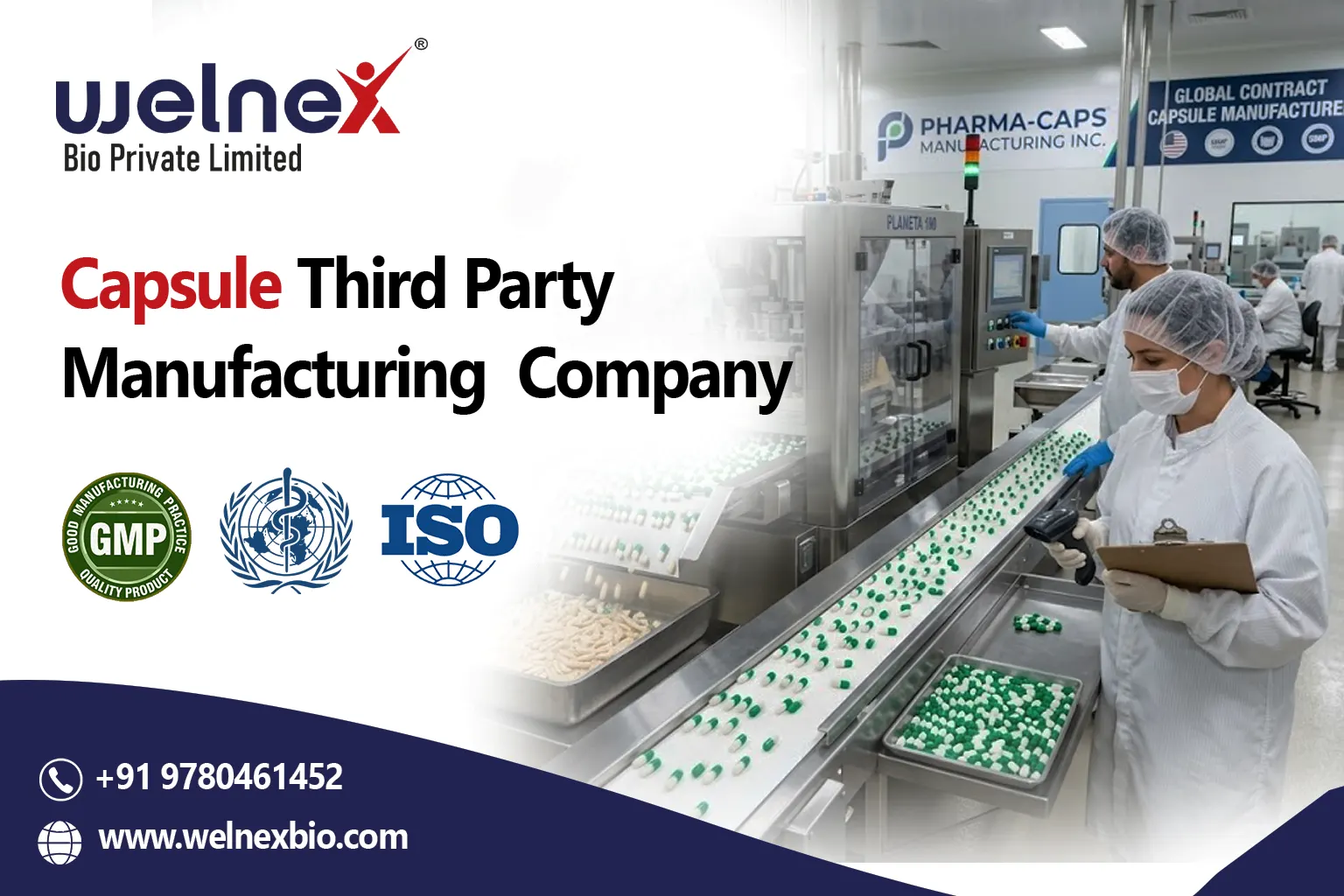
Capsule Third Party Manufacturing Company in India: Complete Guide (2026)
Capsules hold a strange kind of trust in the pharma trade. Patients like them because they're easy to swallow and mask bitter formulations well; brands like them because they allow for combination therapies that tablets sometimes can't handle as cleanly. If you're a PCD franchise owner or a distributor thinking about adding capsules to your line-up, the real question isn't whether to do it — it's who should actually manufacture them for you.
That's where a capsule third party manufacturing company comes in. Pick a weak one and you'll spend more time firefighting stock issues than building your brand. Pick the right one, and capsules become just another product line that runs itself in the background.
This piece covers how capsule third party manufacturing works in India, and why a growing number of pharma businesses are choosing Welnex Bio Pvt. Ltd. for it.
What Capsule Third Party Manufacturing Actually Involves
At its core, it's an arrangement where a pharma brand outsources capsule production to a licensed, GMP-certified manufacturer instead of setting up its own plant. The brand handles the sales side — doctor visits, distribution, marketing — while the manufacturer takes care of formulation, filling, quality testing, and packaging. Some call it third party manufacturing, others call it contract manufacturing. It's the same arrangement either way.
You'll typically see this model used by:
- PCD pharma franchise businesses expanding their capsule range
- Distributors wanting to launch capsules under their own brand
- New entrepreneurs entering pharma without heavy upfront investment
- Existing manufacturers needing extra capacity during high-demand periods
Why Most Brands Skip Building Their Own Plant
Setting up a compliant capsule manufacturing unit isn't a quick job. You're looking at drug licences, encapsulation machinery, trained staff, and usually a couple of years before you're actually production-ready. For most PCD franchise owners, that timeline just doesn't make sense.
Working with an established third party manufacturer sidesteps most of this:
- No machinery or plant investment on your end
- Capsules ready to sell within weeks rather than years
- Manufacturing already running under GMP standards
- Access to multiple therapeutic categories under one roof
- Order quantities that scale with your business, not against it
- Every batch quality-tested before dispatch
- Every batch quality-tested before dispatch
For anyone running a lean pharma business, this is usually the fastest route to a real capsule portfolio without the operational baggage.
The Range of Capsules Usually Covered
A manufacturer worth working with should cover more than just one or two segments. Welnex Bio's capsules range includes:
- Anti-biotic capsules
- Multivitamin capsules
- Gastro-resistant capsules
- Soft gelatin capsules for better bioavailability
- Anti-inflammatory and pain-management capsules
- Nutraceutical and combination formulations
Having this spread under a single manufacturer means you're not chasing five different vendors for five different therapy areas — which, once your product count grows, becomes a real operational headache.
How the Manufacturing Process Works
The sequence is fairly standard across most reliable manufacturers, and it helps to know it upfront:
- You share the formulation, composition, and quantity required.
- The manufacturer checks feasibility and shares costing.
- A sample batch is prepared and sent for your approval.
- Packaging and branding elements get finalized.
- Production runs at scale under GMP-controlled conditions.
- Every batch undergoes quality testing before dispatch.
- Finished stock is delivered on the agreed schedule.
Simple on paper, but the consistency of execution is really what separates a dependable partner from one that keeps you guessing.
Why Businesses Choose Welnex Bio for Capsules
Welnex Bio Pvt. Ltd. has been operating out of Panchkula, Haryana since 2017, and over the years it's built a steady base of pharma associates across India who keep coming back for repeat orders.
The product catalogue runs past 500 formulations, covering tablets, capsules, syrups, injectables, and softgels — so most brand owners find what they need without hunting elsewhere. Quality control isn't an afterthought either; every capsule batch is tested before it clears for dispatch, which matters more than it sounds until a competitor's batch runs into trouble.
Delivery timelines get taken seriously too, since late stock is one of the most common complaints in this trade. The company has worked with more than 1,000 pharma associates over the past decade, which reflects a fair amount of repeat trust. Branding and packaging are fully customizable, so the product carries your identity, not a generic label with your name slapped on. And pricing and timelines are laid out clearly from the start — no surprises mid-order.
Capsule Third Party vs In-House Manufacturing
| Factor | Why It Matters | |
|---|---|---|
| WHO-GMP / ISO certification | Confirms the manufacturing process is controlled and consistently validated | |
| Initial Investment | Low | Very High |
| Time to Market | Weeks | Years |
| Regulatory Burden | Handled by manufacturer | Fully on brand owner |
| Flexibility | High (multiple categories) | Limited to own setup |
| Risk | Lower | Higher |
Laid out like this, it's fairly clear why most growing pharma brands go the third party route rather than spending years building their own capsule facility.
Quality Standards That Actually Matter
Cheaper manufacturers tend to cut corners here, and it's usually where things go wrong for brand owners down the line. A dependable capsule manufacturer will test raw materials for purity before production starts, monitor the encapsulation process continuously, run stability testing so the product performs through its full shelf life, maintain complete batch documentation for traceability, and keep the manufacturing environment clean and controlled throughout. Skip any of this and you're gambling with your brand's name — chemists and doctors notice inconsistency quickly, and that reputation is hard to rebuild once it's dented.
Who Should Consider This Model
This works for more than just one type of business. New entrepreneurs looking to enter pharma without burning capital on machinery, existing PCD franchise owners wanting to add capsule segments to their current range, distributors ready to launch their own brand instead of pushing someone else's, and established companies needing extra capacity without expanding their own plant — all of these fit naturally into this model. If any of these describe your situation, partnering with an established third party manufacturing company will likely save you both time and capital compared to going it alone.
Conclusion
Choosing the right capsule third party manufacturing company shapes how smoothly this part of your pharma business runs going forward. Welnex Bio Pvt. Ltd. brings close to a decade of experience, a wide capsule portfolio, GMP-compliant production, and delivery timelines that actually hold up.
Whether you're building out a PCD franchise, moving from distribution into your own brand, or an established company that simply needs more manufacturing capacity — this is a partnership worth having in place.
Want to discuss your capsule requirement? Get in touch with Welnex Bio Pvt. Ltd. or call +91 9780461452
FAQs
1. What's the minimum order quantity for capsules?
It depends on the specific product and formulation — get in touch for numbers relevant to your requirement.
2. Is the manufacturing facility GMP certified?
Yes, and that standard is maintained consistently across every batch.
3. Can I use my own brand name and packaging?
Yes, full custom branding and packaging support is included.
4. Which areas do you supply to?
Pan-India, manufactured out of the Panchkula facility in Haryana.
5. Do you support PCD franchise businesses specifically?
Regularly — it's one of the core groups this setup is built around.
6. How soon can I expect my first order?
Depends on the product and quantity, but turnaround tends to run faster than the industry norm.